

Dubai Airports faced 111 threat alerts, 17 missile strikes during Iran conflict
CEO Paul Griffiths says all injured during alerts have fully recovered
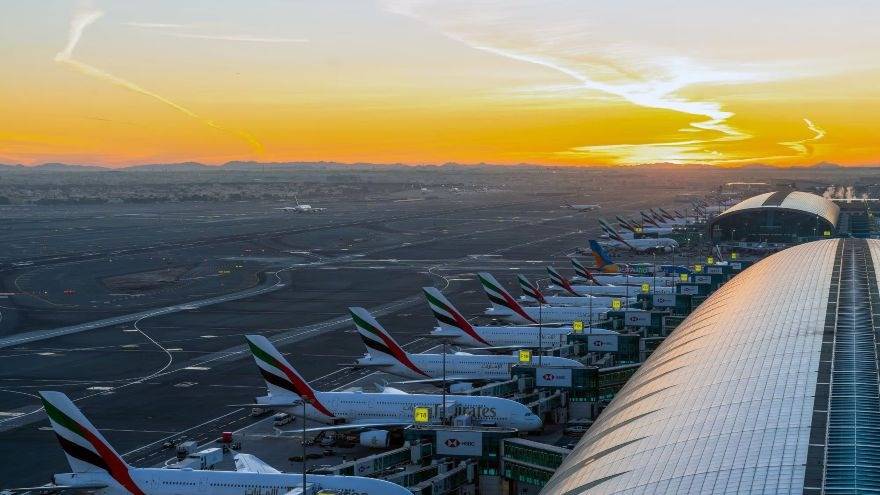
DUBAI – Dubai Airports withstood 111 threat alerts and 17 ballistic missile strikes during the regional conflict this year, with most incidents causing minimal damage and all people injured during the alerts now fully recovered.
Dubai Airports CEO Paul Griffiths revealed the figures during an international media briefing hosted by Dubai Media Office on Thursday, describing an extraordinary period for the aviation sector as the conflict disrupted air travel across the region. Despite the unprecedented security situation, Dubai International Airport (DXB) continued operating while passenger traffic began a sharp recovery after falling significantly during the height of the disruption.
Griffiths said the response required airport teams to learn and implement procedures for an unprecedented situation within hours. He said the experience demonstrated the importance of preparedness, rapid communication and coordination between the airport, government authorities and security systems.
Zero deaths
Griffiths highlighted the absence of fatalities and the limited number of injuries recorded during the crisis.
“The most satisfying statistics: there were zero deaths and very, very limited casualties. I'm very pleased to say that all of those people have now fully recovered,” he said.
Most injuries were minor and occurred as people rushed towards shelters after receiving alerts. Griffiths said some people fell while moving too quickly during the early stages of the crisis, after which airport teams worked to calm the situation and maintain control.
Dubai Airports came under pressure as the regional conflict escalated following US-Israel attacks on Iran, with Tehran targeting Gulf countries, including the UAE, using drones and missiles. Dubai International Airport was also targeted by Iranian drones.
Griffiths credited the UAE government’s communication during the crisis with enabling Dubai Airports to respond quickly and take measures to protect passengers and employees.
He also praised the effectiveness of the UAE’s air defence systems and said the airport remained confident in the security environment throughout the period of hostilities.
Traffic rebound
The security disruption had a substantial impact on passenger volumes, but the recovery has been rapid.
Monthly traffic fell to 2.5 million passengers in March before increasing to 5 million in June and 6.3 million in July. The July figure represented a 26 per cent increase in a single month.
Dubai Airports handled 31.5 million guests during the first half of 2026, despite the disruption. The airport had previously been targeting close to 100 million passengers for the full year, but Griffiths said the latest outlook was considerably more conservative.
The airport is now projected to handle around 70 million passengers by the end of 2026. Griffiths said the 100 million milestone, previously expected to be within reach this year, could instead be achieved by the end of 2027.
DXB closed 2025 with a record 95.2 million guests, while the airport processed 18.6 million passengers during the first quarter of 2026. The Q1 figure represented a 23.4 percent decline from the same period a year earlier.
Griffiths described the recovery as a “trampoline bounce”, saying passenger numbers had fallen sharply before rebounding.
“We go down, we hit the trampoline, and then we bounced even higher than before,” he said.
Airlines return
International connectivity is also rebuilding, with Dubai Airports’ capacity currently back at around 84 percent of pre-crisis levels and customer numbers at approximately 78 percent.
Griffiths said several European airlines had temporarily withdrawn from the Dubai market during the disruption, although carriers were preparing to restore services ahead of the winter season.
He said some of the airlines currently missing from the schedule had announced plans to return on October 25, coinciding with the beginning of the winter season. He also pointed to strong advance bookings for November and December as an encouraging indicator of demand.
Air France had resumed services to Dubai but subsequently paused operations to DXB until September 10 following renewed escalation in the US-Iran conflict.
Griffiths said he expected most of the remaining absent airlines to return during the winter season and that Dubai’s connectivity would be broadly restored by the end of the year.
Dubai is currently connected to 104 countries and 260 cities, according to Griffiths. He also expects the number of cities served directly from Dubai to continue increasing as airlines introduce newer aircraft capable of flying longer routes efficiently.
He previously said the number of cities directly connected to Dubai could rise from around 240 to a higher level by mid-2027, supported in part by advances in smaller, longer-range aircraft.
What’s next for Dubai Airports?
Griffiths said the temporary withdrawal of some European airlines during the summer was partly influenced by commercial considerations rather than a long-term retreat from Dubai.
Northern Hemisphere airlines faced a strategic choice when the summer season began in March, as uncertainty coincided with a traditionally softer travel period. Some carriers opted to redeploy aircraft towards stronger European leisure markets.
Griffiths said he understood the decision but stressed the importance of Dubai to international aviation networks.
He said the Gulf region handles around 100 million connecting passengers, with Dubai accounting for approximately 45 percent of that market.
The airport’s traffic mix has also remained broadly stable despite the disruption. Connecting passengers and those travelling directly to or from Dubai continue to account for roughly 45 percent and 55 percent of traffic respectively, depending on the month and direction of travel.
Business travel has remained a significant component of demand, while India, Saudi Arabia and the UK continue to rank among Dubai’s largest markets.
Griffiths said the distribution of traffic across the wider network remained broadly normal, with markets outside the most affected areas continuing to show resilience.
He also pointed to Dubai’s previous experience of recovering from major shocks, including the global financial crisis and the Covid-19 pandemic, during his nearly two decades leading the airport organisation.
The latest disruption is also expected to influence future airport planning. Griffiths said Dubai Airports could reinforce certain measures and introduce design changes at the new airport to make the infrastructure more resilient following lessons from the Iran conflict.
As passenger traffic rebuilds, Dubai Airports remains focused on restoring connectivity, bringing back missing carriers and expanding the network, while the longer-term target of reaching 100 million annual passengers moves towards 2027.